


 Font size:
New figures released Tuesday by the Bureau of Labor Statistics show that Michigan is again the national leader in job loss and unemployment rate. Michigan lost 1.5 percent of its employment from 2006 to 2007. The state’s unemployment rate went up from 6.9 percent in 2006 to 7.2 percent in 2007, the highest average annual rate the state has seen since 1993. The state’s current 7.1 percent unemployment rate is the highest in the nation.
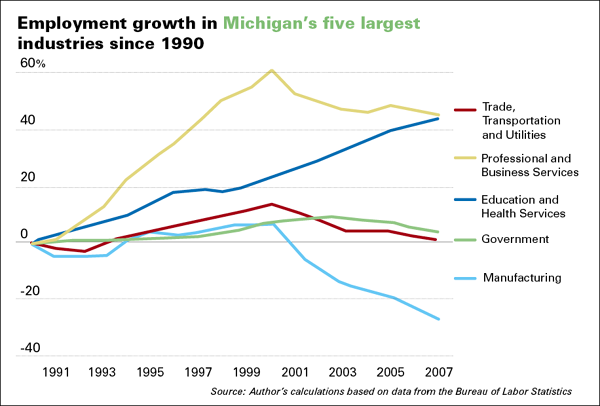
Michigan also started off 2008 by shedding an additional 3,900 nonfarm jobs, although that change was not statistically significant, according to the BLS, and the state unemployment rate dipped from a high of 7.4 percent.
Since 2002, Michigan has lost 5 percent of its total nonfarm employment. Overall, national employment over the same period increased 6 percent. The only other state to lose jobs over this period was Ohio, which lost 0.4 percent of its employment.
Michigan’s decline has been deep and broad. Since 2002, Michigan lost 19 percent of its manufacturing jobs, 17 percent of its construction jobs, 12 percent of its natural resources and mining jobs, 11 percent of its information jobs, and lesser losses in financial activities, professional and business services and government.
However, the auto workers that remain appear to have growing wages. Between 2001 and 2006, average wages at auto manufacturing plants increased by 27 percent, according to the Quarterly Census of Employment and Wages. Compensation is now over $88,000 annually. These figures do not include benefits packages.
Michigan policymakers are largely abstaining from implementing policies that would improve Michigan’s situation. Lansing is currently discussing how to promote fringe industries in alternative energy, and reregulating Michigan’s electricity generation. Not only do such diversions ignore the fundamental problems Michigan faces, but they take policy further away from a competitive market.
There is one area where pending legislation could improve Michigan’s business structure. A bill introduced by State Rep. David Agema, R-Grandville, would prevent the Department of Environmental Quality from enacting environmental rules that are more stringent than federal policies. This would decrease the regulatory burden on businesses while maintaining safety measures that meet federal guidelines.
But what’s lacking in Lansing is a serious discussion of labor and tax reforms that would improve Michigan’s economy and help deliver it from the current stagnation. We can no longer afford arguments for the status quo that might benefit one group at the expense of the state as a whole. The state should consider a right-to-work law and eliminate one of Michigan’s major taxes — sales, income or business — if it wants to reverse its precipitous economic decline. Unless there is transformational change in Lansing, we can expect further depressing numbers from the BLS.
#####
James M. Hohman is a fiscal policy research assistant with the Mackinac Center for Public Policy, a research and educational institute headquartered in Midland, Mich. Permission to reprint in whole or in part is hereby granted, provided that the author and the Center are properly cited.

The Mackinac Center for Public Policy is a nonprofit research and educational institute that advances the principles of free markets and limited government. Through our research and education programs, we challenge government overreach and advocate for a free-market approach to public policy that frees people to realize their potential and dreams.
Please consider contributing to our work to advance a freer and more prosperous state.


