Since my job as fiscal policy director of a think tank requires me to watch the State of the State address every year, I have often wondered what I might say if I were governor. After a decade of analyzing state budgets and Michigan’s economy, I think my remarks would go something like this:
It is a pleasure to be here to deliver my very first State of the State address to this full chamber. My remarks will be different from my predecessors’ in two ways. First, I did not craft these remarks around pithy quotes that could be easily extracted by the media. Too many speeches by too many politicians are designed to solicit good press coverage rather than convey substantive ideas.
Second (and related), my speech is void of applause lines. It has, in recent years, become customary to place invited guests of heroic stature in our gallery and then dramatically recount the ways they have saved kids from ignorance, created jobs or served honorably in a theater of war. This omission will prevent legislators from leaping to their feet in raucous applause with the predictability of Pavlov’s dogs at the sound of a bell.
In exchange for meaningless but clever turns of a phrase, I will offer the troubling but blunt truth:
Michigan is dying. The Great Lake State most of us remember from our youth is being replaced by a poorer, less competitive one. Consider just a few economic measures.
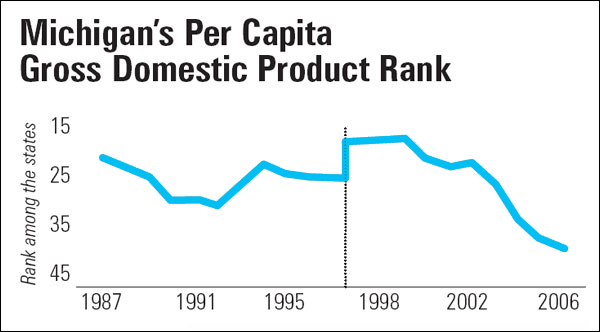
First, Michigan’s rank among the 50 states in per capita state Gross Domestic Product has tumbled from a high of 16th in 1999 to 39th in 2006.
State GDP is simply the value of all goods and services produced within the geographical borders of a state. This ranking is important to us because Michigan has typically done better during national booms and worse during recessions. But starting in 2002 something changed. With a growing national economy we should have been climbing in the GDP rankings, yet we continue to fall. This is not a simple, cyclical event.
Second, Michigan’s per capita personal income is 7.8 percent below the national average, a rate worse than during the Great Depression.
Let me drive this point home. If present trends continue, the people of Alabama will on average have higher incomes than the people of Michigan in just three years.
Lastly, Michigan has the highest unemployment rate of any state in the nation at 7.6 percent. If the Great Lake State has another year of net job losses as is expected, it will represent the largest string of year-over-year job losses since the Great Depression.
Now, I ask you: Does anyone think any of these numbers will improve as a result of last year’s $1.4 billion tax hike? The economic law of demand is clear. If you raise the price of anything — wheat, jobs or work, for instance — you get less of it. When the state hikes the cost of laboring and living in Michigan they will get less of it. We must reverse these trends and do so with dramatic reforms.
For starters, Michigan must become the 23rd right-to-work state, which is perhaps the greatest economic development tool in the state’s reach.
Between 2001 and 2006, states with voluntary unionism enjoyed state GDP growth of 18.1 percent. Michigan grew by only 3.4 percent during the same period. From July 2005 to July 2006, nine of the top 10 states in terms of population growth were right-to-work states. The numbers suggest that this is no coincidence.
We must repeal the hated Michigan Business Tax — which repealed the hated Single Business Tax — and we must offset revenue losses by reducing the size and scope of state government. The Mackinac Center has compiled a list of spending reductions that would save the state $1.3 billion without cutting any core government functions.
The good news is that Michigan is a great state with abundant natural resources, such as water and human talent. Moreover, opportunity can spring from crisis. Someone once said that politicians will do the right thing, but only after they have exhausted every other option. Michigan may have reached that point. Let us move forward.
#####
Michael D. LaFaive is director of the Morey Fiscal Policy Initiative at the Mackinac Center for Public Policy, a research and educational institute headquartered in Midland, Mich. Permission to reprint in whole or in part is hereby granted, provided that the author and the Center are properly cited.

The Mackinac Center for Public Policy is a nonprofit research and educational institute that advances the principles of free markets and limited government. Through our research and education programs, we challenge government overreach and advocate for a free-market approach to public policy that frees people to realize their potential and dreams.
Please consider contributing to our work to advance a freer and more prosperous state.


