


 Font size:
Not a single school in Michigan was awarded any of the $94 million available through federal Teacher Incentive Fund grants when the final winners were announced earlier this month. Of course, that’s not surprising since you cannot win a federal grant competition when you barely even apply.
Of the 143 applications submitted, only four came from Michigan, a state with 552 school districts and more than 200 charter public schools. If the federal government and private foundations nationwide are funding merit pay programs with millions of dollars, why don’t the unions in Michigan want their teachers to get a piece of the action?
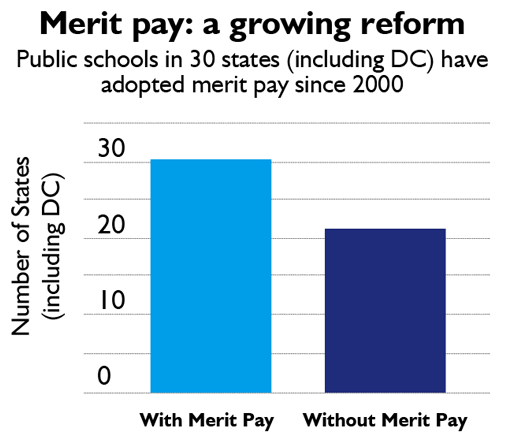
The intent of the TIF program is to encourage school districts to adopt alternative teacher compensation plans that base teacher pay, in part, on student achievement. This federal program, which will result in thousands of teachers earning significant performance-pay bonuses, is just one such initiative being undertaken across the country.
However, in Michigan only three districts have begun to adopt any form of merit pay. Nonetheless, perhaps the system in Michigan is fine just the way it is — students are learning and teachers are getting paid in the manner they deserve. Then again, maybe not.
Michigan teacher salaries are among the highest in the nation. Unfortunately, union policies have not produced commensurate levels of student achievement. According to the Bureau of Labor Statistics, the average teacher in Michigan earned approximately $57,000 during 2006, compared to the national average teacher salary of approximately $50,000. The average wage of Michigan teachers also dramatically outpaces the average per capita income of $34,000 in the state.
On the other hand, on comparative measures of student achievement, Michigan students routinely rank in the middle of the pack. Certainly, it would seem that taxpayers and legislators would want a greater bang for their educational buck.
One major problem is that the current teacher compensation system has the wrong incentives. In Michigan, nearly all teachers are paid according to the single salary schedule. This compensation method rewards teachers for experience and level of degree. If a teacher earns a masters degree, she gets a significant pay bump. If she stays in the job for another year, she gets yet another raise. Despite the research that shows that teacher seniority after the first five years does little to impact student achievement, individual teachers still get their raises year after year. As for extra degrees, no research definitively links increased credentials to higher student performance either.
Teacher unions have designed a system to protect the weakest teachers, not to promote student achievement. As long as a teacher doesn’t do anything egregious, the checks keep coming and the teacher unions get their cut. The only real accountability measure in the state is the competition that school choice provides, and, wouldn’t you guess, the unions want to do away with that too.
Research suggests that of all the factors that can impact student achievement in schools, teacher quality matters most. Although it is true that teachers do more than merely teach students how to read, write and do arithmetic, students should be able to demonstrate the academic progress they make during the 180-day school year on standardized tests.
Measuring a teacher by his students’ academic performance is an accurate way to determine, to some degree, the quality of his work. Under the system defended by unions, an excellent teacher, whose students demonstrate significant learning gains, earns the same amount as the teacher who clocks in and then checks out. Therefore, there is little incentive for teachers to go that extra mile.
If Michigan would like to see teacher quality improve, policymakers need to take a long, hard look at the way teachers are compensated. Local school districts should do everything within their legal powers to link teacher pay to performance. They can begin by following and expanding upon the examples of Michigan districts that have already instituted this policy.
Across the nation, progressive districts are undertaking merit pay plans to motivate their teachers to innovate and work harder. Even though teachers do not choose the education profession for the money, they, like most people, respond to incentives. When a portion of their wages is attached to student performance, the incentives change. Although teachers can earn higher salaries for performing better under a merit pay system, students will be the ones who truly win.
#####
Marc Holley is a doctoral fellow at the University of Arkansas’ Department of Education Reform and an adjunct fellow with the Mackinac Center for Public Policy, a research and educational institute headquartered in Midland, Mich. Permission to reprint in whole or in part is hereby granted, provided that the author and the Center are properly cited.

The Mackinac Center for Public Policy is a nonprofit research and educational institute that advances the principles of free markets and limited government. Through our research and education programs, we challenge government overreach and advocate for a free-market approach to public policy that frees people to realize their potential and dreams.
Please consider contributing to our work to advance a freer and more prosperous state.


