Font size:
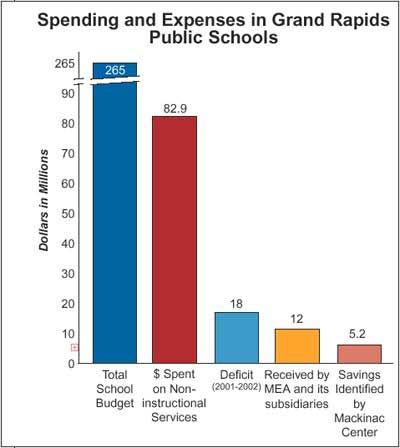
Last year, the Mackinac Center for Public Policy conducted a fiscal analysis of the Grand Rapids Public School System to see whether private contracting could help the district dig itself out of a runaway budget deficit, which registered an $18 million shortfall for the 2001-2002 school year.
This analysis showed that by restructuring the district's health benefits plan and privatizing non-instructional services, Grand Rapids could achieve savings amounting to nearly a third of its deficit and possibly whip itself into financial shape within a few years. The alternative would be draconian budget cuts-and possibly teacher layoffs-that might affect the quality of education offered to Grand Rapids students.
Unfortunately, district and union politics prevented district officials from adopting the Mackinac Center plan.
The budget documents from Grand Rapids made clear why the school district was in financial arrears. Like many districts throughout the state, it maintains a bloated bureaucracy that has outstripped its incoming revenue. Its total budget, which currently stands at $265 million, is subject to runaway health-care benefits that have increased in cost by 10.5 percent each year for the last three years. The cost of other benefits has increased by from 5 to 8 percent. Overall, expenses for the Grand Rapids Public Schools are rising at an annual rate of 6.2 percent. Yet, its revenues are growing at a rate of only 3.9 percent.
Part of the reason for this is that students are leaving for better education alternatives elsewhere. In Michigan, when a student leaves one school district for another, the "foundation grant" money provided per pupil by the state goes with them. That grant currently amounts to $6,582 per student. In the 2001-2002 school year, Grand Rapids Public Schools lost 222 more students than anticipated. That comes to a loss of around $1.4 million. The district anticipates losing even more students in the 2002-2003 school year. It also expects to run a $16 million deficit if it cannot successfully make changes to reduce the cost of operating the district.
After examining financial and operational information from the district, the Mackinac Center recommended that Grand Rapids competitively contract with private vendors to provide bus and food service for its students, janitorial services for upkeep of its schools, and health-care benefits for its employees. The Center conservatively estimated the possible savings from such a plan at $5.2 million per year, nearly a third of the district's projected deficit. The actual savings would almost certainly be more.
Competitively bidding out such services is a common-sense management practice used in business, government, nonprofit corporations, and school districts across the country. Indeed, in a 2001 Mackinac Center survey of 228 Michigan school districts, 71 reported outsourcing at least one of their major non-instructional services.
Even the Michigan Education Association (MEA) union, which officially opposes school district efforts to save money and improve service by contracting out, has itself contracted with private vendors for food, security, janitorial and mailing services at its headquarters in East Lansing. Presumably, the union does this to save money, improve quality, or both.
This was not the first time that the Mackinac Center had offered its assistance to a school district. In January 2001, parents in the Redford Union Schools made statewide news when they began hosting bake sales in an unsuccessful attempt to raise money to preserve teachers' jobs that were being eliminated due to budget woes.
Mackinac Center Senior Vice President Joseph P. Overton contacted the district and suggested that privatization might offer a way to keep the teachers and save money at the same time. After conferring with the district superintendent, the Center drafted a proposal containing cost-saving opportunities. "We sometimes lose sight of the simple fact that children are the focus of our school system, and that teachers are the ones who work hard each day to make a difference in their lives," Overton told the Detroit News. "If we have to choose between overly expensive support services and teachers, we say protect the teachers," he said.
The Mackinac Center was so certain that its plan to outsource non-instructional services would cost less while delivering higher quality that it guaranteed $350,000 in savings to the Redford Union Schools. In other words, if the district, having kept its teachers and following the Center's savings plan, failed to reap this amount or more in savings, the Center would give the difference to the district out of its own pocket.
Regrettably, district and union politics prevented Redford Union from accepting the offer, and administrators followed through with their plans to do away with teachers' jobs. The same appears to be happening now in Grand Rapids.
Grand Rapids Public Schools Superintendent Dr. Patricia Newby and Carol Crawford, chief financial officer, have indicated that the district has been exploring many elements of the Mackinac Center's recommendations and agreed that there are substantial savings to be found in non-instructional outsourcing. Unfortunately, neither believed that implementing the changes was possible, mainly due to opposition from the MEA, which currently collects union dues and fees from the district's custodians, food service workers, bus drivers, teachers and clerical workers.
The union and its subsidiaries receive revenue of more than $12 million from the district and its employees each year. If Grand Rapids Public Schools were to privatize their non-instructional services, or competitively bid out for health insurance, the MEA would probably lose much of this sum and the political leverage that comes with it. The union typically will fight tooth-and-nail to prevent a school district from taking this kind of action, whether or not it would help the schools keep more teachers in the classroom. School district representatives justifiably fear a negative MEA public relations campaign that would put severe pressure on the school board to reject any privatization proposal.
Instead, public school officials often follow the path of least resistance. In the current public school political environment, it is easier to blame budget cuts on stingy taxpayers rather than it is to stand up to labor unions and other vocal opponents of sound management. In Grand Rapids, this has already taken the form of an outright denial of services: The district no longer provides bus transportation for its high school students. Next year it intends to close the deficit further by packing more students into each classroom. Such steps would probably not be as necessary if the district had taken the Mackinac Center's advice.
Of course, those who lose most from this situation are the students, who never see the additional teachers and facilities that school districts' wasteful overspending could have paid for. Over time, such policies cause a stagnation and deterioration of educational quality that adds fuel to the school choice movement, and causes more and more students to take advantage of the choices already out there.
Grand Rapids Public Schools are facing a budget crisis that requires extraordinary action. But before any real progress can be made, district officials have to muster the courage to stand up to the school employees' union and do what is necessary to benefit their district and its students.
Nathan Crosslin is coordinator of the Mackinac Center for Public Policy's Education Reform Leadership Project.