Font size:
School districts and colleges across the nation are slowly reducing their use of outsourcing, preferring instead to keep the operation of non-educational services in-house.
According to American School & University's 7th Privatization/Contract Services Survey, 23 percent of school districts in the United States did not contract out any services in 2001, compared with 21.7 percent in 1999 and 23 percent in 1997. As for colleges and universities, 6 percent did not outsource any services in 2001, compared with 5.3 percent in 1999.
Those institutions that do outsource non-educational services are not as enamored with the practice as in years past. The percentage of school districts that privatize five or more services dropped to 9 percent from 15 percent two years ago (the last year this survey was conducted). The percentage of colleges and universities that outsource five or more services shrunk to 34 percent from 44 percent in 1999.
The survey was mailed to 1,000 school financial officials and 1,000 college financial officials in May. The result was a 29 percent response rate for schools and a 32 percent response rate for colleges and universities, or 30 percent overall.
What's Being Outsourced?
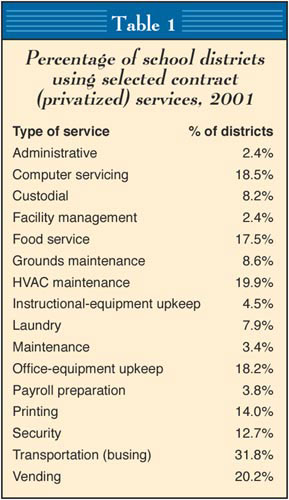
Table 1 identifies the percentage of school districts that currently contract out for various types of non-educational services. For purposes of this survey, privatized non-educational services are operations-such as transportation, janitorial or food services-and are separate from the academic mission of the institution, which are turned over to outside companies.
Among the most commonly privatized services at K-12 institutions are transportation (31.8 percent), vending (20.2 percent), heating, ventilation, and air conditioning maintenance (19.9 percent), computer servicing (18.5 percent) and office-equipment upkeep (18.2 percent).
While school districts increased their use of privatized services in some areas (administrative, computer servicing, laundry, printing, security, transportation and vending), more than half of the categories posted a drop in the use of outsourcing. The largest growth was reported in the outsourcing of laundry services, which more than quadrupled from two years ago to 7.9 percent of all school districts, and security, which grew by more than 50 percent to 12.7 percent of districts. Custodial, facility management, grounds maintenance and HVAC maintenance experienced the biggest shift away from being outsourced, as more districts brought these services in-house.
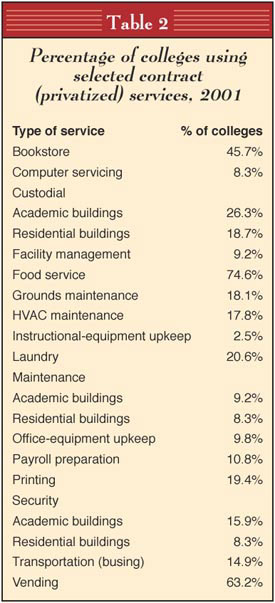
Table 2 details those services most often outsourced by colleges and universities. Among the most common include food service (74.6 percent), vending (63.2 percent), bookstore operations (45.7 percent), custodial work of academic buildings (26.3 percent) and laundry (20.6 percent).
Although six categories saw an increase in the percentage of colleges and universities outsourcing these services, twice the number of categories experienced a shift away from privatization and back to in-house operation. The largest percentage increases were posted in transportation, which more than doubled to 14.9 percent from two years ago, and computer servicing, which increased by 80 percent to 8.3 percent of higher-education institutions.
Looking Forward
The use of privatized services is expected to decline at both school districts and colleges, compared with projections made in past years. About 25 percent of school districts report they will most likely outsource additional non-educational services in the near future (compared with 27 percent in 1999 and 42 percent in 1997). Roughly 36 percent of higher-education institutions expect their use of outsourcing to increase over the next few years (compared with slightly more than 37 percent in 1999 and 54 percent in 1997).
Larger school districts are more likely than smaller districts to predict that their use of outsourcing will increase. The tendency to privatize non-educational services is highest among districts with enrollment greater than 5,000 and lowest in districts with fewer than 1,000 students. At the college level, institutions with more than 10,000 students are more likely to increase future use of outsourcing.
The reasons schools and colleges privatize non-educational services are similar. Higher-educational institutions most often choose outsourcing because the private vendor offers better equipment (41.3 percent) or because it saves time (34.9 percent). School districts always preferred to keep operations in-house, although these same two factors (better equipment and time-savings) received the highest percentage of respondents' preferences (32.5 percent and 25.7 percent, respectively) as reasons for outsourcing.
Public opinion and accountability were listed by both school districts and colleges as the primary reasons outsourcing of non-educational services was not practiced, and why operations remained or were brought back in-house.
MPR Editor's note: Michigan Privatization Report conducted a survey of privatization in Michigan school districts in the summer of 2001. The results of the survey can be found www.mackinac.org/3721.
Joe Agron is the editor-in-chief of American School & University magazine. For more than 70 years, AS&U has been the leading education facilities/business publication for school and university administrators.