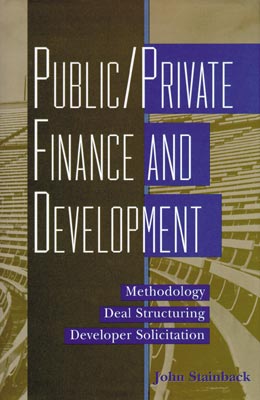
Public/Private Finance and Development: Methodology, Deal Structuring and Developer Solicitation
By John Stainback
New York: John Wiley & Sons, Inc., 2000, 287 pages
A quarter-century ago, "privatization" was not in any dictionary. The term became prevalent sometime in the late 1970s and Prime Minister Margaret Thatcher of Great Britain became the first national leader to make it a centerpiece of economic policy. It has been in the dictionaries ever since.
Here in the United States, it wasn't until the 1980s-when governments at all levels were straining under the weight of huge, expensive bureaucracies the taxpaying public increasingly resented-that privatization began to really take off. Here it has become particularly popular at the level of local government.
But it has to be done right. There's nothing worse for a "reform" idea than a poor implementation that leads observers to reject the idea outright. It isn't enough to simply declare, "Government is too big and its services are antiquated and costly. Just turn them over to the private sector." Any township, city, county or state official knows that rushing into privatization without doing one's homework first is a prescription for failure.
Fortunately, experts like John Stainback are telling us how to avoid the pitfalls and ensure success. In his latest work, Public/Private Finance and Development, he provides the reader with all the information he or she needs to forge profitable public/private partnerships. This is not a book for the generalist; it's not a quick and easy read. It deals with what has become a complex subject, but it walks the reader through the minefields and provides invaluable advice. Stainback describes both the advantages and disadvantages of public/private partnerships. If you're a government official who would like to explore partnerships with the private sector but aren't sure how to go about it, this book is for you. If you're a developer, architect, contractor, investment banker, attorney, or an engineer, and if you're interested in partnering with the public sector, this book is for you as well.
Stainback is a nationally known authority on privatization strategies and is often called upon to provide expert assistance in shepherding public/private partnerships to successful implementation. He recently formed a new company, Stainback Public/Private Real Estate LLC, based in Malvern, Pa.
Which projects are best suited for a public/private partnership approach? In this age of high-tech and niche expertise, there are few projects the public sector can bring to fruition entirely on its own. Stainback's shows how to implement privatization plans for new building construction, rehabilitation and expansion of existing buildings, infrastructure improvements, and to a lesser extent for the management of airports, wastewater treatment plants, correctional facilities, and other services.
Even more important, Stainback goes to great pains to emphasize the importance of what would seem to the layman like minor details. For example, he devotes an entire chapter to the process of soliciting developers. He explains the formula for putting together a proper RFP (Request for Proposal), the notice a governmental body issues to inform private developers of a new enterprise and what will be required. This document, which sets the stage for success or failure of the entire venture, must be not only informative, but must also attract the developer. "Avoid introducing highly technical matters," Stainback advises. "If government and university officials are constrained by an abnormal amount of regulations, specifications, and/or legislative requirements, they should make the developer aware of these additional hurdles by summarizing these issues, but they should not incorporate attachment after attachment at the RFP stage. These details can be fully addressed after a developer is selected. If the RFP is one or two inches thick, most developers will not want to incur the time and expense of adequately addressing these issues until he or she has been selected."
By the time the reader is finished with Public/Private Finance and Development, he or she will have no excuses for not knowing how to structure a win-win privatization deal for both the government and the firms with which it does business.
Another useful portion of the book deals with the structuring of finance plans. Using the "Stainback Five-Part Public/Private Finance and Development Approach" illustrated in Chapter 7, projects that initially appear to be financial losers can be transformed into attractive opportunities that will attract capital.
But all this might still seem like so much theory if it were not for Chapter 10, "Eight Case Studies." This is where the rubber meets the road. In very illuminating detail, Stainback explains how actual public/private projects around the country came together. They include the Oregon Arena in Portland; the Oyster School/Henry Adams House in Washington, D.C.; the Veterans Administration Medical Center Complex in Durham, N.C.; and the White Flint Metro Station in Bethesda, Md. From conceptualization to implementation, these case studies provide detailed information that can improve the chances of success for any public/private partnership.
With the tremendous volume of local and state privatizations here in Michigan in recent years, it would have been a nice touch for MPR readers if Stainback had at least one Michigan case study. Though none are here, the lessons to be learned from other places are certainly as applicable to future efforts in Michigan as well as anywhere else.
Stainback draws upon 24 years of experience in the real-estate industry, including 15 years in public/private finance and development, to write this book. With more and more helpful guides like this at our disposal, there is no excuse for poorly planned or poorly executed public/private projects any more.
Lawrence Reed is president of the Mackinac Center for Public Policy.